Module 3: Good Guys vs. Bad Guys — Bacteria Are Partners
Before we sort the good guys from the bad guys, let's get clear on what we're talking about. A bacterium is a single-celled living thing so tiny that millions fit on the tip of a pencil. They eat, grow, and reproduce. Your gut has about 38 trillion of them. Today you'll find out most of them are working for you.
Last module, you followed a piece of broccoli all the way to the colon. You learned that trillions of bacteria live there, waiting for fiber to arrive. But we never answered the most important question: who are those bacteria?Quick poll: raise your hand if you think most gut bacteria are harmful bad guys. Today we find out the truth and it might surprise you. Think of it this way: not every plant in a garden is a rose some are weeds, some are just grass. But the garden still needs all of them to stay balanced.
Concepts
This module challenges the "good vs. bad" binary and introduces students to the concept that most gut bacteria are neutral or helpful partners. Students learn that balance and diversity matter more than eliminating "bad" bacteria. The module includes a physical sorting game where students move around the classroom to categorize bacteria scenarios.
Learning Objectives
By the end of Module 3, students will be able to:
-
Explain that most gut bacteria are neutral or helpful, not harmful.
-
Describe the roles of beneficial bacteria (digestion, vitamin production, immune support).
-
Identify conditions that promote helpful bacteria vs. harmful bacteria.
-
Understand that balance and diversity are more important than eliminating all "bad" bacteria.
Concepts
Concept 1: Most Bacteria Are Helpful or Neutral
🌱 Garden Link: A healthy garden has hundreds of plant species most are helpful or harmless. Only a few are true weeds.
Concept 2: Helpful Bacteria Have Jobs
🌱 Garden Link: These are your earthworms, bees, and soil bacteria invisible workers that keep everything growing.
Concept 3: Balance Matters More Than Elimination
🌱 Garden Link: Pulling out every single weed can damage the soil. A little variety even the "bad" kind keeps the ecosystem strong.
Concept 4: You Control the Balance
🌱 Garden Link: You are the gardener. What you eat, how you sleep, and how much stress you carry all decide what grows.
Concept 1: Most Bacteria Are Helpful or Neutral
Your gut is home to hundreds of bacterial species. Only a small percentage are potentially harmful. Most are:
- Helpful: They do important jobs like digesting fiber, making vitamins, and protecting you from invaders.
Like earthworms and bees your garden can't thrive without them.
- Neutral: They live in your gut without helping or harming you. They're simply part of the community.
🌱 Like grass that quietly grows in a garden they fill space without causing problems.
- Harmful (when there are too many): A few kinds of bacteria can cause problems if they grow too much. Healthy gut bacteria usually keep them under control.
Like weeds a few are not a problem. But if they spread too much, they can take over the garden.
.png)
The Four Jobs of Your Gut Gardeners
Job 1: Fiber Processors
Main Idea:Bacteria transform fiber into a new nutrient (SCFAs).
What the Bacteria Do: When you eat fruits, vegetables, beans, and whole grains, some of the fiber travels all the way to your large intestine because your body cannot digest it. That's where your helpful gut bacteria get to work. They break down the fiber and turn it into tiny nutrients called short-chain fatty acids (SCFAs).

What It Does for You:
These tiny nutrients help: Feed the cells lining your large intestine.Keep your gut lining strong and healthy. Support a healthy digestive system. Without enough fiber, your gut bacteria have less food to eat and produce fewer of these helpful nutrients.
🌱 Garden Connection: Compost System. In a garden, dead leaves and plant scraps are added to a compost pile. Tiny living organisms break them down into nutrient-rich compost that feeds the soil and helps plants grow. Your gut works the same way. Fiber is like the garden scraps. Helpful bacteria are like the compost workers. They turn fiber into nutrients that help keep your gut healthy.
Teacher Guidance Learning Goal Students understand that fiber feeds beneficial bacteria, and beneficial bacteria transform fiber into nutrients that help keep the gut healthy.
Teacher Background:Humans digest most carbohydrates, proteins, and fats in the small intestine. Most dietary fiber is not digested because humans lack the enzymes needed to break it down. Instead, fiber reaches the large intestine where beneficial bacteria ferment it into short-chain fatty acids (SCFAs), including acetate, propionate, and butyrate. Butyrate is the primary energy source for many cells lining the colon.
Job 2: Vitamin Makers
What the Bacteria Do:While breaking down fiber (Job 1), helpful gut bacteria are also busy doing another important job. As they grow and carry out their normal activities, some of these bacteria produce certain vitamins, including Vitamin K and some B vitamins.Vitamins are tiny nutrients your body needs in small amounts to grow, repair itself, and carry out hundreds of important jobs every day. Although you only need a little of each vitamin, your body cannot work properly without them.Most of the vitamins your body needs come from the healthy foods you eat. However, your helpful gut bacteria provide extra support by making some vitamins right inside your large intestine.
What It Does for You: The vitamins made by helpful bacteria help your body stay healthy in many different ways. Vitamin K helps your blood clot after a cut and supports strong, healthy bones.B vitamins help your body turn food into energy so your cells can work properly. Some B vitamins also help your body make healthy red blood cells and repair damaged tissues. Even though gut bacteria do not make all of the vitamins your body needs, the vitamins they do make provide extra support that helps keep your body functioning every day.
🌱 Garden Connection: A healthy garden needs more than sunlight and water. It also needs healthy living soil filled with tiny organisms that help release nutrients plants need to grow. You rarely see these tiny helpers at work, but without them plants struggle to grow strong. Your gut works the same way. Helpful bacteria quietly produce some of the vitamins your body needs every day. You cannot see them working, but they help keep your body growing, repairing itself, and doing the many jobs needed to stay healthy. Just as healthy soil helps plants thrive, healthy gut bacteria help your body thrive.
Teacher Guidance
Learning Goal:Students understand that vitamins are nutrients needed in small amounts for normal body function and that helpful gut bacteria contribute to producing some vitamins while carrying out their normal activities.
Teacher Background: Vitamins are organic nutrients required in small amounts for growth, metabolism, and overall health. Most vitamins are obtained through a balanced diet. However, beneficial bacteria living in the large intestine also contribute to the production of Vitamin K and several B vitamins, including folate (B9) and biotin (B7).These bacterial contributions supplement but do not replace the vitamins obtained from food. Avoid suggesting that gut bacteria produce all of the body's vitamins or that they eliminate the need for healthy eating.
Main Idea:Helpful bacteria help produce some vitamins that support your whole body.

Job 3: Immune Teachers
1. What the Bacteria Do:Your body has a defense team called the immune system. Its job is to protect you from harmful germs, such as some bacteria and viruses, that can make you sick.Helpful gut bacteria do more than make nutrients and vitamins. They also help teach your immune system. As they live in your intestines, they communicate with your body's defense cells and help them learn the difference between things that are safe and things that could be harmful.Instead of attacking everything they find, your immune system learns to make smart decisions about what should stay and what should be removed. This training helps your body stay healthy and balanced.
Main Idea:Helpful gut bacteria help teach your body's defense team how to protect you from harmful germs while leaving helpful bacteria and healthy cells alone.

2. What It Does for You: A well-trained immune system helps protect your body every day.It helps: Fight harmful germs that can make you sick. Recognize the difference between helpful and harmful bacteria. Avoid attacking harmless things, such as healthy foods and the beneficial bacteria living in your gut.Keep your body healthy by responding only when protection is needed.When helpful bacteria train your immune system, they help your body make better decisions about what belongs and what doesn't.
🌱 Garden Connection: The Wise Gardener
Imagine taking care of a beautiful garden. Not every plant is a weed. Some are flowers, vegetables, and fruit plants that help the garden grow. A wise gardener learns to recognize the difference before pulling anything out. Removing every plant would ruin the garden, while leaving every weed would allow it to take over. Helpful gut bacteria teach your body's defense team the same skill. They help it recognize what belongs in your body and what could cause harm, so your gut garden stays healthy, balanced, and growing.
Teacher Guidance:
Learning Goal:Students understand that the immune system is the body's defense team and that helpful gut bacteria help train it to recognize harmful germs while leaving helpful bacteria, healthy cells, and harmless substances alone.
Teacher Background:The immune system protects the body from disease-causing organisms and helps repair damaged tissues. Approximately 70% of the body's immune cells are found in and around the digestive tract, where they constantly interact with food and microbes. Beneficial gut bacteria help shape immune development by communicating with immune cells and promoting immune balance. Rather than replacing the immune system, they help it learn when to respond and when not to.
Job 4: Space Keepers
What the Bacteria Do:Your large intestine is like a busy neighborhood where trillions of bacteria live together. Every bacterium needs a place to live and nutrients to survive. When helpful bacteria are healthy and plentiful, they cover the lining of your intestines and use the available nutrients before harmful germs can.
Because most of the space is already occupied, harmful germs have fewer places to attach, grow, and multiply. Scientists call this colonization resistance—beneficial bacteria naturally make it harder for harmful microbes to become established.Rather than constantly fighting harmful germs, helpful bacteria protect your gut simply by already being there first. By filling the available space and using the available nutrients, they help maintain a healthy, balanced microbial community
Helpful gut bacteria help protect your gut by filling the available space and using available nutrients, making it difficult for harmful germs to settle, grow, and take over.
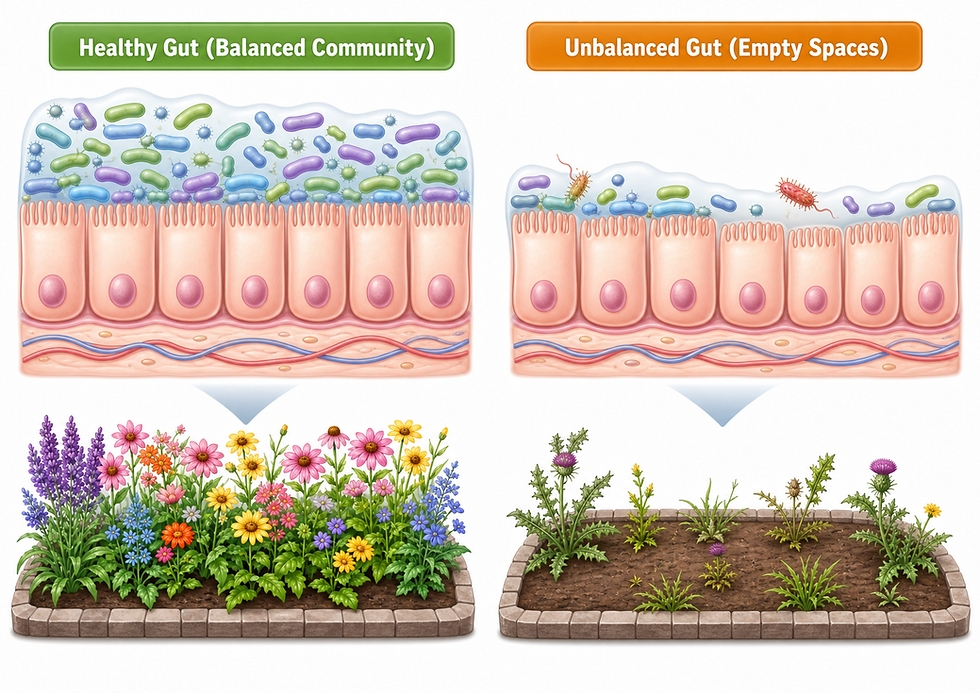
What It Does for You: A healthy community of gut bacteria helps protect your body every day.
It helps:
-
Keep harmful germs from settling in your gut.
-
Reduce the chance that harmful bacteria will multiply.
-
Maintain a healthy balance of beneficial bacteria.
-
Support a healthy digestive system by keeping the gut community stable.
When beneficial bacteria fill the available space, harmful germs have fewer opportunities to grow and cause problems. This helps your gut remain healthy, balanced, and able to carry out all the important jobs you've learned about in this module.
🌱 Garden Connection: A Full Garden Has No Room for Weeds
Imagine a beautiful garden where every patch of soil is filled with healthy flowers, vegetables, and strong plants. These plants use the sunlight, water, nutrients, and space available in the garden.When every space is already filled with healthy plants, weeds have very little room to take root and spread.Your gut works the same way. Helpful bacteria fill the available space along the lining of your large intestine and use the nutrients that are available. Because the "gut garden" is already full of healthy bacteria, harmful germs have a much harder time settling in and growing.A healthy garden isn't protected because the flowers attack the weeds. It's protected because the healthy plants are already growing well. Your gut works the same way—a full, healthy community of beneficial bacteria naturally helps keep harmful germs under control.
Teacher Guidance:
Learning Goal: Students understand that beneficial bacteria protect the gut not by fighting harmful microbes directly, but by filling available space and using available nutrients leaving no room for harmful bacteria to establish themselves.
Teacher Background: Colonization resistance is a well-documented mechanism of gut protection. Beneficial bacteria occupy physical attachment sites on the intestinal lining and compete for nutrients, making it difficult for pathogens to establish a foothold. This is one reason that antibiotic-associated diarrhea occurs when antibiotics reduce beneficial bacteria,pathogens can colonize the now-empty space.
Concept 3: Balance Matters More Than Elimination
Most people assume the goal is simple: get rid of all the bad bacteria and keep only the good ones. But your gut doesn't work that way — and trying to eliminate every harmful bacterium can actually make things worse.
A small number of potentially harmful bacteria living quietly in your gut is completely normal. As long as helpful bacteria are plentiful, they keep the harmful ones in check — crowding them out, using up nutrients, and preventing them from growing too fast. The ecosystem stays stable.
The real problem isn't the presence of harmful bacteria. It's when the balance tips — when helpful bacteria decrease and harmful bacteria are free to multiply unchecked. This can happen after a course of antibiotics, a bout of illness, a long stretch of low-fiber eating, or chronic stress. Suddenly there's less competition, more open space, and harmful bacteria can take over.
This is why scientists focus on restoring and maintaining balance rather than wiping out every microbe. A diverse, well-fed gut community is its own best defense.
What throws off the balance:
- Antibiotics necessary sometimes, but they reduce all bacteria, helpful and harmful alike
- A low-fiber diet starves helpful bacteria, giving harmful ones an opening
- Chronic stress signals the body to change the gut environment in ways that favor less helpful species
- Illness can temporarily reduce helpful bacterial populations
What restores the balance:
- Eating a variety of high-fiber plant foods
- Getting consistent sleep
- Managing stress where possible
- Allowing time after antibiotics for the gut community to rebuild
🌱 Garden Link:
Pulling out every single plant weeds and flowers leaves bare soil. Bare soil erodes, dries out, and becomes a perfect place for invasive plants to take over. A healthy garden isn't perfectly weed-free. It's balanced with strong, healthy plants keeping everything else in check.
👩🏫 Teacher Guidance
Learning Goal: Students understand that the goal of gut health is not to eliminate all bacteria but to maintain a healthy balance — and that disrupting that balance (through antibiotics, poor diet, or stress) is when problems arise.
Teacher Background: The gut microbiome exists in a state of dynamic equilibrium. Opportunistic pathogens like Clostridioides difficile are often present in small numbers in healthy individuals but are controlled by the surrounding microbial community. When that community is disrupted — most commonly by broad-spectrum antibiotics — these organisms can proliferate and cause illness. This is a key reason clinicians sometimes recommend probiotics or a high-fiber diet during and after antibiotic treatment.
In the classroom: Ask students: "If antibiotics kill the bad bacteria, why don't doctors just give everyone antibiotics all the time?" This usually opens a good discussion about balance, side effects, and antibiotic resistance.
Concept 4: You Control the Balance
Here's the most important idea in this whole module: you are the gardener.
Your gut community is not fixed. It changes based on the choices you make every single day — what you eat, how much you sleep, how much stress you carry, and how active you are. Within 24 to 48 hours of a major diet change, researchers can detect shifts in the gut microbiome. That means the garden inside you is responding to you right now.
This is actually good news. It means you're not stuck. If your gut balance has been off — from illness, stress, antibiotics, or months of low-fiber eating you can start shifting it back with your next meal.
Your daily choices and what they do:
Choice
Effect on the Gut Garden
Eating fiber-rich foods (fruits, vegetables, beans, whole grains)
Feeds helpful bacteria, supports diversity
Eating mostly processed, low-fiber foods
Starves helpful bacteria, reduces diversity over time
Getting 8–9 hours of sleep
Supports a stable gut environment
Chronic sleep deprivation
Can shift gut composition toward less helpful species
Regular physical activity
Associated with greater gut bacterial diversity
Chronic stress
Changes gut chemistry in ways that favor less helpful bacteria
Taking antibiotics when needed
Necessary and sometimes life-saving but rebuilding afterward matters
🌱 Garden Link:
You are the gardener. The garden doesn't tend itself. What you plant, what you water, and what you leave alone all decide what grows. Feed the right plants and they'll crowd out the weeds. Neglect the garden and the weeds take over. Every meal is a watering can. Every good night of sleep is sunlight. You decide what grows.
👩🏫 Teacher Guidance
Learning Goal:
Students understand that lifestyle choices especially diet directly affect the composition of their gut microbiome, and that they have real agency over their gut health starting today.
Teacher Background:
The gut microbiome demonstrates remarkable plasticity. Studies show measurable shifts in microbial composition within 24–48 hours of dietary change (David et al., 2014). Fiber intake is the single strongest dietary predictor of microbiome diversity. Sleep deprivation and psychological stress both influence gut composition through changes in gut motility, immune signaling, and hormone levels. Exercise has been independently associated with higher microbial diversity, though the mechanism is not fully understood.
In the classroom:
After presenting this concept, pause and ask students: Based on what you know now, what's one thing you ate this week that probably helped your gut garden? What's one thing that probably didn't? Keep the tone non-judgmental the goal is awareness, not guilt. Then say: Your next meal is a chance to feed your garden.
Avoid:
Framing this as good food vs. bad food in a moralistic way. The message should be: more variety, more plants, more fiber not perfection.
Key Vocabulary — Module 3
Bacteria
Single-celled living things that are too small to see without a microscope. Your gut contains about 38 trillion of them.
🌱 Garden Link: Like the tiny insects, worms, and microbes living in garden soil.
Beneficial Bacteria
Bacteria that help your body by digesting fiber, producing some vitamins, training your immune system, and protecting space in your gut.
🌱 Garden Link: Like earthworms and bees that help a garden thrive.
Colonization Resistance
The way beneficial bacteria protect your gut by filling up space and using nutrients, leaving little room for harmful bacteria to move in.
🌱 Garden Link: A full garden leaves very little room for weeds to grow.
Short-Chain Fatty Acids (SCFAs)
Helpful nutrients produced when gut bacteria break down fiber. These nutrients help feed and support the cells lining your large intestine.
🌱 Garden Link: Similar to compost nutrients that help plants grow.
Balance
Having enough beneficial bacteria to keep potentially harmful bacteria under control. Gut health is about maintaining a stable ecosystem, not removing every harmful microbe.
🌱 Garden Link: A healthy garden is balanced — not completely free of weeds.
Microbiome
The entire community of microorganisms living together in your gut.
🌱 Garden Link: Like all the plants, insects, fungi, and soil organisms living together in a garden ecosystem.
Garden Vocabulary Connection:
Every garden has special words like soil, roots, compost, and weeds. Scientists also use special words to describe the hidden garden living inside you. Learning these words helps us understand how our gut ecosystem works.
Myth vs. Fact — Module 3
Myth 1
Most bacteria in your gut are bad and cause diseases.
Fact
Most gut bacteria (90%+) are helpful or neutral partners that support your health. Only a tiny minority are harmful.
🌱 Garden Link: A few weeds don't ruin a garden as long as flowers and vegetables are thriving.
Myth 2
Antibiotics only kill the "bad" bacteria that make you sick.
Fact
Broad-spectrum antibiotics kill both helpful and harmful bacteria, often leading to a temporary imbalance in the gut microbiome.
🌱 Garden Link: Using a strong weed killer can sometimes harm your favorite flowers too.
Myth 3
Your gut microbiome is set at birth and cannot be changed.
Fact
The microbiome is highly dynamic. Choices like eating more fiber and getting sleep can shift the balance within just 48 hours.
🌱 Garden Link: You are the gardener. What you plant and water today determines what grows tomorrow.
Activity: Sorting Game — Beneficial vs. Harmful Bacteria
In this activity students will physically move around the classroom to sort different bacteria scenarios into 'Beneficial' or 'Harmful' categories. This game reinforces the concept that environmental factors and lifestyle choices directly influence gut balance.
How to Play
- Set up two areas of the room labeled 'Beneficial' and 'Harmful'.
- Read a scenario card aloud to the class.
- Students move to the side of the room they think the scenario describes.
- After everyone has moved, reveal the answer and explain the reasoning.
Scenario Cards
Beneficial (The Partners)
- Fiber-rich snack: A student eats an apple. The bacteria in the gut turn the fiber into nutrients to feed the gut wall.
- Good night sleep: A student gets 9 hours of sleep, keeping the gut environment stable for helpful bacteria.
- Probiotic food: A student eats yogurt with live cultures, adding more helpful workers to the team.
Harmful (The Invaders/Imbalance)
- Food poisoning: A student eats spoiled food containing harmful bacteria that can cause a tummy ache.
- Antibiotic use: A student takes medicine that kills an infection but also accidentally removes many helpful gut bacteria.
- High-sugar diet: Eating only processed snacks can starve helpful bacteria and allow less helpful ones to take over.
Class Discussion Questions
- Were most of our scenarios beneficial or harmful? Why is it important that we have more of the 'good guys'?
- What happens to the 'bad guys' when the 'good guys' are plentiful?
- How does eating fiber change the game board?
🌱
Garden Connection: This game is like identifying which bugs in a garden help the plants (bees/worms) and which ones might damage them (locusts). A healthy garden is always balanced by the gardener's choices.
👩🏫 Teacher Guidance
Learning Goal: Students practice categorizing gut microbiome scenarios and recognize how daily choices impact bacterial balance. Facilitation Tip: Encourage students to explain why they chose a side based on the four bacterial jobs they learned earlier in the module.
Exit Ticket — Module 3
Question 1: Fill in the Blank
Helpful gut bacteria turn fiber into tiny nutrients called ___________ that keep the gut lining healthy.
Correct Answer: Short-chain fatty acids (SCFAs)
Question 2: Multiple Choice
What is the main goal of gut health?
A) Get rid of all bacteria in the gut.
B) Keep all harmful bacteria but feed them fiber.
C) Maintain a healthy balance with plenty of helpful bacteria.
D) Only have three types of bacteria in the microbiome.
Correct Answer: C) Maintain a healthy balance with plenty of helpful bacteria.
Why others are wrong:
A is wrong because you need bacteria to live; B is wrong because you don't want harmful ones to take over; D is wrong because diversity (hundreds of types) is better.
Question 3: Short Answer
Describe one way your life choices act as a "gardener" for your gut. Use one of the four jobs of bacteria in your answer.
Guidance: Look for students to connect a choice (food, sleep, stress) to a specific outcome (making vitamins, protecting space, digesting fiber).
Strong Answer Examples:
• "When I eat an apple, I am watering my fiber-processing bacteria so they can make nutrients for my gut wall."
• "By getting enough sleep, I am helping my 'space keeper' bacteria stay strong so they can prevent bad germs from moving in."